Rāda ziņas ar etiķeti Latvian food. Rādīt visas ziņas

trešdiena, 2015. gada 11. novembris

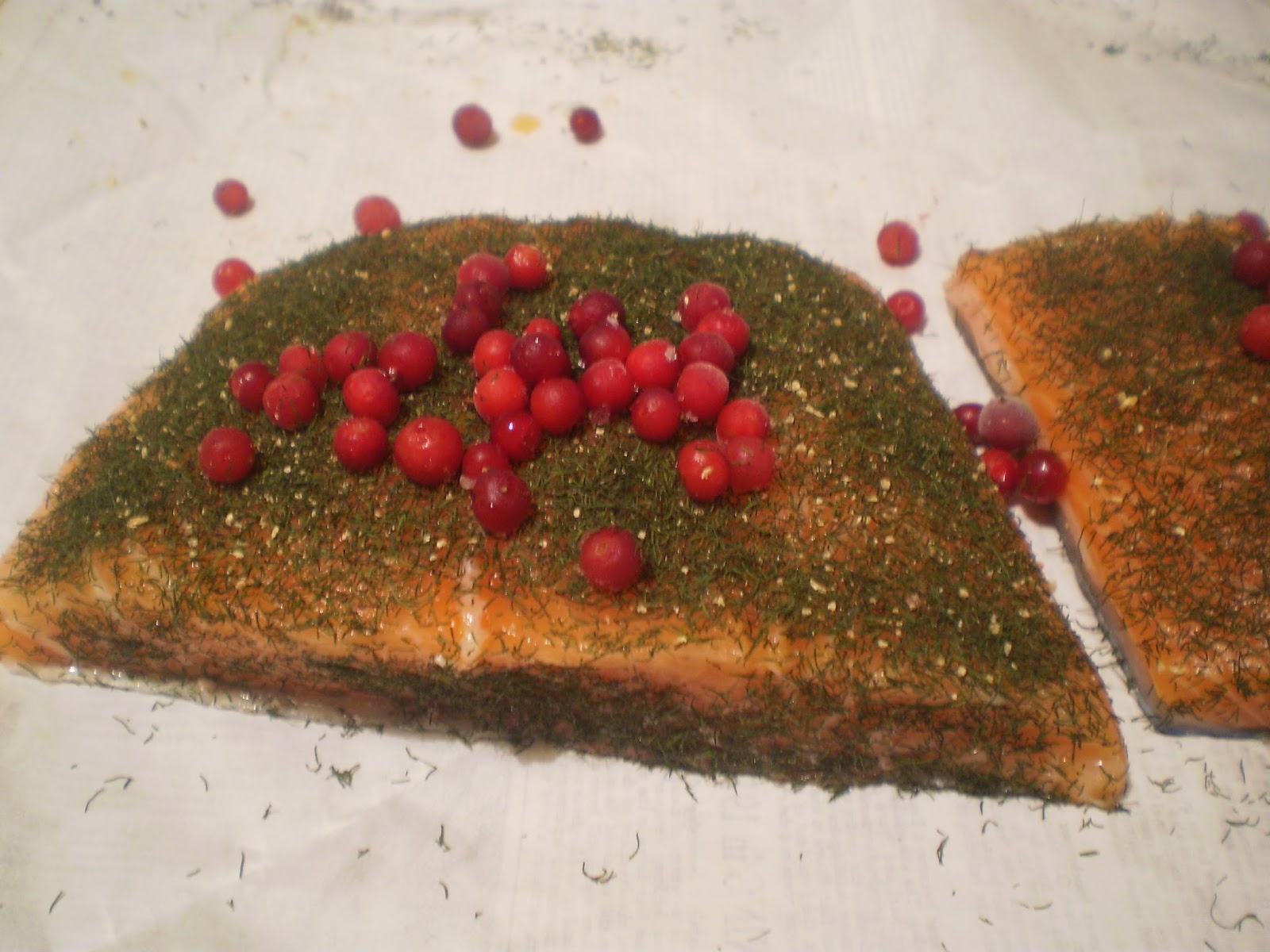
HAWAIIAN ALAEA SALT CURED WILD BALTIC SALMON WITH DILL AND LINGONBERRIES


Wild Baltic salmon is a well-known local delicacy in Latvia. We are very lucky because besides brightly colored farmed salmon from Norway we can still spin in our rivers or buy in the Fish Pavilion of the Central Market wild Baltic salmon. Actually, salmon as a color is quite often used in everyday Latvian and it resembles orangy pinkish tint of Baltic wild salmon flesh.

There are many different ways of preparing salmon, but the easiest and fastest method is to mild-cure it. Mild-curing is a century-old food tradition ideally suited to Latvia’s climate. Initially it was method to preserve raw fish, therefore the proportion of salt and sugar was important. Nowadays dry cure has become sweeter as in the fridge era there is no need to keep fish preserves for long periods of time. I found that Hawaiian alaea salt is not only a good preservative but also it's vulcanic clay particles complements the color and taste of the wild salmon. Seasoning can vary from classic dill to seaweed, juniper and fresh berries (lingonberries, elderberries, cloudberries). Addition of pink peppercorns just before serving is a modern twist to give it a nervous finish. For Latvians lingonberries are very traditional wild berries everyone can pick for free in the state owned forests. When ripe they are sour sweet with a bitter edge. Dill is by far the most popular herb in Latvia. It's used to season meats, fishes and veggies, it's also used to flovour all sorts of picles and finally as a garnish.

Instead of applying pressure by weighing fillets down, some modern cooks wrap them tightly in several layers of cling film. While this latter technique is probably more convenient, it may not give the best results. Fish meat must change its structure to firm and dense, as salt draws the moisture out. Dry cure dissolves in it creating a brine, where fully covered fish can be kept for months. We, Latvians eat mild-cured salmon on thinly sliced buttered toast (white bread) for breakfast or on festive occasions. A very similar curing technique is applied on salmon in Scandinavian countries to prepare world famous Gravadlax.

Hawaiian alaea sea salt

Wild Baltic salmon


2 salmon fillet, pin-boned but with skin on (approximately 600g)
60g Hawaiian alaea salt
30g Demerara sugar
2 handfuls of lingonberries (Vaccinium vitis idaea)
2-3 tbsp. dried dill (or 6tbsp. finely chopped fresh dill)
1 tsp. ground white pepper
pink peppercorns for serving

Clean the fillets with kitchen paper, but do not wash them and remove any bones. Mix the alaea salt, sugar and white pepper. Lay two fillets skin down, rub them with dill and work it into the topside of the fillets. Then add an even layer of lingonberries. Scatter over the dry cure mix so that the flesh is completely covered and press on vigorously. Flip over so the thick edge of one fillet fits on the top of the thin edge of the other. Put it in a tray that is just slightly wider, cover the fillets with a wooden board and place a weight on the top. Put the tray into the fridge for 48 hours. Before serving pat the fillets dry with kitchen paper and sprinkle with pink peppercorns. Lay the fillets skinside down and cut off thin slices with a sharp knife. Serve it cold on buttered toast or with a poached duck egg. Fillets fully covered by brine can be kept in fridge for at least 2 weeks.

svētdiena, 2015. gada 8. novembris

APPLE DESSERT - OVEN BAKED APPLE HALVES WITH CINNAMON AND WHIPPED CREAM


I bake orchard fresh apples each autumn. My mum would start baking apples in early September when the first apples are ripe. Of all my autumn desserts this is the one that has best stood the test of time. Apple baking is a tradition that has been around for a long time. I choose a sharp apple variety like locally grown 'Antonovka' or you can use 'Bramley' or 'Egremont Russet' if you prefer sweeter taste.


6 sharp cooking apples
1 tbsp ground cinnamon
1/2 tsp ground cloves
1/2 tsp ground nutmeg
1/2 tsp ground ginger
3 tsp dark muscovado or Demerara sugar (or maple syrup, or honey)
few glugs of calvados (optional)

Whipping cream to serve

Mix all the spices and sugar  together. Cut the apples in half and core them. Put the apple halves on the baking tray lined with baking paper, skin side down, and fill the holes with sugar and spice mix and drizzle over the calvados. Bake them in the pre-heated oven (180 degrees C) for 15-20 minutes depending on the apple size and variety. Bake the apples to a fluffy texture. Allow them to cool slightly. Meanwhile whip the cream to a stiff-peak stage. Divide the baked apples between four serving plates (and don't forget to mop up all the sticky juices) and top with a whipped cream.

In this recipe I'm using fresh Saigon cinnamon from Cinnamon Hill.

ceturtdiena, 2015. gada 5. novembris

OVEN BAKED BALTIC SALMON WITH DILL, RED PEPPERCORNS AND LINGONBERRIES


Salmon fishing in Latvia was originally confined to the capture of ascending spawners in the so called salmon rivers e.g. those natal rivers where salmons return to spawn. We have many salmon rivers therefore no wonder that salmon formed a part of Latvian diet for many centuries. Damming (expansion of hydroelectric power plants) and polllution have caused a serious decline in salmon stock in the past decades. As a result of human intervention, nowadays natural salmon stock has increased and we are enjoying flavour packed wild salmon dishes again.

This is a light and very simple recipe that provides a clean tasting and succulent meat. Dill layer protects it from drying out and lingonberries add an acidic touch. However, my secret ingredient in this recipe is Hawaiian alaea salt. Its pinkish brown clay particles underlines natural taste of the salmon and adds some earthy notes to it. 


Hawaiian alaea salt

Ready for the oven

... and out of the oven
4 wild Baltic salmon fillets (skin on and pinboned)
2 hanfuls of dill
2 handfuls of lingonberries
1 teaspoon pink peppercorns in brine
1 teaspoon (dried) pink peppercorns
Hawaiian alaea salt
a glug of olive oil
a glug of white wine

Crush in the mortar and pestle (dried) pink peppercorns together with a few pinches of alaea salt. Pinch the skin side of each fillet and lightly score a few times, 5 cm apart (shallow incisions). Turn them skin side down and sprinkle over a handful of chopped dill and lingonberries, brined pink peppercorns, and few pinches of salt and crushed pink peppercorns. Gently pat it down with your hands. Place the fillets on the baking tray lined with parchment, skin side down, and drizzle over a glug of both, olive oil and white wine. Grill (bake) in the medium hot oven (180-200 degrees C) for around 17 minutes. Serve it with potato puree.

pirmdiena, 2015. gada 24. augusts

SORREL SOUP WITH POACHED EGG


Sorrel soup is a springtime classic in Latvia. Sorrel is a harbinger of spring, amongst the first greens to harvest after a tiresome winter. Most of broad leaf sorrel (Rumex acetosa) I have seen thrives almost abandoned, nearly wild along the other weeds. Its French relative buckler leaf sorrel (Rumex scutatus) is too mild for a soup. No wonder the sorrel in local markets is sold by weight and it is cheap. Traditionally sorrel soup is made from smoked pork stock adding sorrel leaves, potatoes, pearl barley and garnished with a hard boiled egg and a dash of sour cream. I prefer oxtail stock which develops a strong flavour but does not overpower the soup with a smokiness. I like the sorrel tartness to dominate the soup. Its lemony tang delicately cuts the soft set white and runny yolk of poached egg. You can also add some other early spring greens - wild garlic (ramps), nettle or chicken weed to the soup.

First make a rich, slow cooked oxtail stock enriched with onion, garlic, carrot, parsley root, celery root or stalk, parsnip, fennel, different peppercorns, sage, thyme, dill and parsley stalks, bay leaves, juniper berries, orange peel and  mace.


1,5 l oxtail stock
300 g broad leaf sorrel (two hefty bunches)
150 g pearl (hulless) barley
2-3 waxy potatoes
eggs for poaching
sea salt
freshly ground black pepper

Rinse and soak the pearl barley for a few hours to overnight before cooking. Peel and cut potatoes into cubes. Cut the sorrel leaves into chiffonade (thin slices or shreds) having removed any thick stems. Bring the stock to the boil, add soaked pearl barley, reduce the heat and simmer until it's nearly ready (al dente), add potatoes and continue simmering till they are nearly cooked. Stir in the sorrel leaves. Correct seasoning. When the sorrel is mostly wilted (it takes a few seconds!), poach the eggs in the soup. Serve immediately.

ceturtdiena, 2015. gada 20. augusts

NETTLE BREAD WITH TEFF FLAKES


This is variation on a basic bread recipe. Nettle leaf powder pairs very well with nutty and earthy flavour of teff flakes. Nettle can be found wild in many parts of the world. In Latvia nettles are among the earliest green plants of the spring to forage. Fresh nettle leaves can be easily brewed into a tea or turned into a pesto. Late spring is the perfect time to harvest nettles and dry them. The benefits of nettles have been documented for centuries. They are a source of nutrients, contain a number of essential minerals, like iron, calcium, potassium and magnesium. If you can not find a nettle leaf powder, you may try to find a nettle leaf tea at local pharmacy or health food shop and crash or grind the dry leaves into a powder yourself.


400 g strong white bread flour
100 g teff flakes
5 g fast-action yeast
375 ml tepid water
2 heaped tbsp nettle leaf powder
1 tbsp wheat gluten (for a bit more lift)
1tsp sea salt
a glug of olive oil

Mix the flour, flakes, gluten, salt and yeast in a large bowl. Make a well in the centre, then add the oil and water, and mix well. If the dough seems a little stiff, add 1-2 tbsp water, mix well then tip onto a lightly floured work surface and knead. Once the dough is satin-smooth, place it in a lightly oiled bowl and cover with a tea towel. Leave to rise for 2 hours or until doubled in size or place in the fridge overnight. Line a baking tray with baking parchment. In a small bowl mix nettle leaf powder with 3 tbsp of water until smooth paste forms.

Tip the risen dough out onto a lightly floured work surface and flatten it down to gently push out the air, spoon the nettle paste on top of dough and fold the dough several times and then gently mould the dough into a ball. Place it covered by a tea towel on the baking parchment to prove for a further hour until doubled in size. 

Meanwhile heat an oven to 220C (fan 200C). Sprinkle the loaf with teff flakes and make 2 cm deep slashes across the top of the loaf with a sharp knife. Bake for around half an hour until golden brown and the loaf sounds hollow when tapped underneath. Cool it on a wire rack completely before slicing.

Teff flakes are available at Tobia Teff .

trešdiena, 2015. gada 24. jūnijs

TOMATO AND CUCUMBER SALAD WITH SOUR CREAM DRESSING


This is the most typical summer salad and it accompanies most meals in summer. It consists of pieces of tomato, cucumbers and sometimes finelly chopped onions, and is spiced with a handful of chopped dill and scallions or chives. And sour cream dressing gives a deliciously tangy edge to it.


4 medium or small cucumbers
3 meaty tomatoes
150 ml sour cream (20-30% fat content)
5 scallions or around 15 chives
bunch of dill
sea salt flakes
freshly ground black pepper

Cut tomatoes into chunks, cut cucumbers in half, lenghtwise, each half cut in half, lenghtwise again, then slice them thinly crosswise. Mixed the vegetables and chopped dill and scalions together in the bowl. Season with salt and pepper, add sour cream and stir it through the salad. Serve with chunks of freshly baked baguette for mopping pale (tomato juices + sour cream) sauces at the end.

svētdiena, 2015. gada 21. jūnijs

HOMEMADE SOUR CREAM

Latvian sour cream

Sour cream (in Latvian skābais krējums) is a key ingredient of almost any traditional dressing or sauce. Sour cream is spoon over baked potatoes, mixed into curd cheese (in Latvian - biezpiens) is added to enrich stews and soups. It's also used in deserts. Moreover, sour cream is churned into artisanal butter. I cann't imagine Latvian cooking without a sour cream, and luckily it's very easy to make at home. 

We are used to milk in its pure form - raw milk (in Latvian svaigpiens) which has not been pasteurised nor homogenised. This is what I call proper milk because milk treatment changes its flavour a lot. Besides, pasterisation kills also lactobacillus and  therefore pasterised milk doesn't ferment naturally but gets spoiled. Similarly, homogenisation brakes the fat into smaler sizes and the fat in milk doesn't anymore separates from the watery emulsion. Pasteurised and homogenised milk may be used in cooking but isn't suitable for fermentation, butter churning or cheesemaking without a further treatment. 

In the raw milk separation of the cream (fat) occurs naturally. Literally if milk is let to sit in the bottle (container) you can skim off the cream by spoon from the top. That's the way the raw cream is obtained. It is still slightly sweetish even it already contains some  lactobacillus. Nowadays, there is no need to skim milk by hand as unpasteurised (raw) cream is sold in different grades of the total butterfat content (single cream, wipping cream, double cream). The most common sour creams are 20 to 30% fat. Accordingly, you need raw cream with the same fat content (between 20 and 30%), if you need to adjust it, go for higher fat content but never lower. Usually I recommend raw whipping cream (35% fat) to made sour cream.

Latvian sour cream doesn't have any particular strain of lactobacillus, but gets its acid making inhabitants from pores or surface of the container the cream is kept and the atmosphere (in old times it was a cellar where a fresh cream was kept in the wooden vessel). Raw cream left at room temperature starts to sour naturally. 

Homemade sour cream is thick, viscous and slightly yellowish. When buying sour cream, be sure to check the fat content. Low fat sour creams (0-15%) are not real sour creams and most likely contain thickeners or other food additives. Store bought sour creams are made from pasteurised milk cultured with mesophilic bacteria - Lactococcus lactis, Lactococcus cremoris, Lactococcus diacetylactis.

homemade sour cream

Homemade sour cream

500 ml raw whipping cream (or other raw cream with a fat content between 20% and 40 %)

Pour whipping cream into a wooden or other container of porous material, or a glass jar. Cover it with a cheesecloth and secure with a rubber band (don't place a tight lid). Keep the jar at room temperature for 1 to 2 days. When fermentation starts, transfer the jar to a fridge (or cellar) as slow fermentation and cold ripening produces more delicate flavour. Cream will set within 2 days. Place a tight lid and keep in fridge for up to 2 weeks.

In UK raw cream is sold at Hook & Son stall in Borough Market. Commercially produced sour cream is available at Lituanica, the largest Lithuanian supermarket chain specialising in Baltic food.


sestdiena, 2015. gada 11. aprīlis

SALT CURED SALMON WITH LINGONBERRIES, DILL AND PINK PEPPERCORNS


Wild Baltic salmon is a well-known local delicacy in Latvia. We are very lucky because besides brightly colored farmed salmon from Norway we can still spin in our rivers or buy in the Fish Pavilion of the Central Market wild Baltic salmon. Unfortunately, the salmon season is now closed, yhat's why I prepared this recipe with store bought Norwegian salmon.

There are many different ways of preparing salmon, but the easiest and fastest method is to mild-cure it. Mild-curing is a century-old food tradition ideally suited to Latvia’s climate. Initially it was method to preserve raw fish, therefore the proportion of salt and sugar was important. Nowadays dry cure has become sweeter. Seasoning can vary from classic dill to seaweed, juniper and fresh berries (lingonberries, elderberries, cloudberries). Addition of pink peppercorns just before serving is a modern twist to give it nervous finish. For Latvians lingonberries are very traditional wild berries everyone can pick for free in the state owned forests. When ripe they are sour sweet with a bitter edge. Dill is by farthe most popular herb in Latvia. It's used to season meats, fishes and veggies, it's also used to flovour all sorts of picles and finally as a garnish.

Instead of applying pressure by weighing fillets down, some modern cooks wrap them tightly in several layers of cling film. While this latter technique is probably more convenient, it may not give the best results. Fish meat must change its structure to firm and dense, as salt draws the moisture out. Dry cure dissolves in it creating a brine, where fully covered fish can be kept for months. We, Latvians eat mild-cured salmon on thinly sliced buttered toast (white bread) for breakfast or on festive occasions. A very similar curing technique is applied on salmon in Scandinavian countries to prepare world famous Gravadlax.


Salt cured salmon with lingonberries


2 salmon fillet, pin-boned but with skin on (approximately 600g)
70g rock salt (or non-iodized sea salt)
30g demerara sugar
2 handfuls lingonberries (Vaccinium vitis idaea)
2tbsp. dried dill (or 6tbsp. finely chopped fresh dill)
1tsp. ground white pepper
pink peppercorns for serving

Clean the fillets with kitchen paper, but do not wash them and remove any bones. Mix the rock salt, sugar and white pepper. Lay two fillets skin down, rub them with dill and work it into the topside of the fillets. Then add an even layer of lingonberries. Scatter over the dry cure mix so that the flesh is completely covered and press on vigorously. Flip over so the thick edge of one fillet fits on the top of the thin edge of the other. Put it in a tray that is just slightly wider, cover the fillets with a wooden board and place a weight on the top. Put the tray into the fridge for 48 hours. Before serving pat the fillets dry with kitchen paper and sprinkle with pink peppercorns. Lay the fillets skinside down and cut off thin slices with a sharp knife. Serve it cold on buttered toast or with a poached duck egg. Fillets fully covered by brine can be kept in fridge for at least 2 weeks.

svētdiena, 2015. gada 29. marts

CHEESE AND SEAWEED COOKIES


This is one version - and there are many - of the classic Latvian cheese cookies. I have made these cookies with equal parts of flour, butter and semi-hard cheese and shaped them crescent like, as I suppose was once customary. In Latvian cookies bear their name from crescent shape and are called radziņi (small horns). In older cookbooks they are called horseshoes (pakavi in Latvian), a name that also derivers from their crescent shape. Traditionally no flavourings are added but cheese pairs very well with seaweed, so I decided to give it a try. I also added egg yolk to make rich and delicate cookies. 

If you bake the cookies in Latvia suggested local cheese is Trikantālers, Cesvaine (aged 6 months) or Vītolberga siers. Otherwise internationally known varieties as Emmental, Gouda, Edam, Cantal, Gruyere or even Cheddar are recommended.


100g plain white flour, extra for dusting
80g butter, softened
80g semi-hard cheese, finely grated
1 free-range duck (or chicken) egg yolk
2 tbsp Mara Seaweed shony and dulse
a generous pinch of Maldon smoked salt flakes

Rub the butter into the flour until it resembles fine breadcrumbs. Add the grated cheese, seaweed and egg yolk, and mix together until evenly combined. Gather the dough and roll into a log, about 5 cm in diameter. Wrap in cling film and refrigerate for at least half an hour. When ready to cook, preheat the oven to 180 degrees. Line the baking sheet with baking parchment. Using a sharp knife, cut the roll into round slices about 7 mm thick and lay them on lined baking sheet. Sprinkle a couple of salt flakes over the top of each cookie. Bake for 7-10 minutes, checking regularly after 7 minutes. The cookies should be lightly golden on top but not browned. Leave on the baking sheet for a minute, then carefully transfer to a wire rack to cool completely.

These delicate cookies will keep for a couple of days in an airtight container.

trešdiena, 2014. gada 17. decembris

MILD CURED (LOW SALTED) PIKEPERCH


Freshwater pikeperch is a well-known local delicacy in Latvia. There are many different ways of preparing it, but the easiest and fastest method is to mild-cure it. Mild-curing is a century-old food tradition ideally suited to Latvia’s climate. Initially it was method to preserve raw fish, therefore the proportion of salt and sugar was important. Nowadays dry cure has become sweeter. Seasoning can vary from classic dill to seaweed, juniper and fresh berries (lingonberries, elderberries, cloudberries).  Instead of applying pressure by weighing fillets down, some modern cooks wrap them tightly in several layers of cling film. While this latter technique is probably more convenient, it may not give the best results. Fish meat must change its structure to firm and dense, as salt draws the moisture out. Dry cure dissolves in it creating a brine, where fully covered fish can be kept for months. We, Latvians eat mild-cured pikeperch on thinly sliced buttered toast (white bread) for breakfast. A very similar curing technique is applied on salmon in Scandinavian countries to prepare world famous Gravadlax.


2 pikeperch fillet, pin-boned but with skin on (approximately 600g)
50g rock salt
20g Maldon smoked sea salt flakes
30g demerara sugar
Mara Seaweed seaweed mix (equal parts of shony, dulse, kombu)
dried dill

Clean the fillets with kitchen paper, but do not wash them and remove any bones. Mix the rock salt, sugar and dill. Lay two fillets skin down and rub them with smoked salt lakes, then add an even layer of seaweed and work it into the topside of the fillets. Scatter over the dry cure mix so that the flesh is completely covered and press on vigorously. Flip over so the thick edge of one fillet fits on the top of the thin edge of the other. Put it in a tray that is just slightly wider, cover the fillets with a wooden board and place a weight on the top. Put the tray into the fridge for 48 hours. Before serving, wipe off most of the cure (seaweed and dill), and pat the fillets dry with kitchen paper. Lay the fillets skinside down and cut off thin slices with a sharp knife. Serve it cold on buttered toast or with a veggie salad. Fillets fully covered by brine can be kept in fridge for at least 2 weeks.


trešdiena, 2013. gada 10. aprīlis

SMELTS EN ESCABECHE


The smelt (Osmerus eperlanus (L.)) is easily distinguishable from all other fish by its very characteristic raw cucumber-like aroma. The anadromous smelt occurs in the coastal waters of Latvia, wintering near the river mouths and entering lower reaches of the rivers for spawning. In wintertime as soon as sea coast and rivers are covered by ice some kind of a unique reality show starts. Ice fisherman, penguin-like figures are squatting on the ice and awaiting to catch the golden fish. For some reason nearly all of them are men. They hope for any kind of catch: roach, perch, pike and other fish. But from January to March, at the mouth of the Lielupe, the Venta, the Daugava in downtown Riga (few hundred meters away from the Old Town) and the Gulf of Riga (Baltic Sea), hundreds of ice fishermen are out to catch some smelt. Sometimes the passion for their hobby is awarded with a significant catch. For locals it is not surprising to see them fishing when the snow and ice have already begun to melt. This year as many as 223 ice anglers were trapped on break-away sea ice floes in the Gulf of Riga necessitating a full-scale rescue operation. Luckily such reclesness did not result in drawnings. Since ancient times a similar operation, usually of lesser scale, is typically required annually. Novella In the Shadow of Death (Nāves ēnā) written in 1899 by the famous Latvian writer Rūdolfs Blaumanis is based on a newspaper account of several fishermen lost at sea on an ice floe. The novella portrays the characters of fourteen fishermen and their reactions as they encounter a life-threatening situation on a dwindling ice floe.
 
The smelts are winter and early spring meal. Most of the smelt recipes on the internet without much variation call for deep frying but I would recommend lighter treatment for the smelts' delicate flesh. Latvian traditionalists would say smelt is best enjoyed hot smoked or pan fried before dipped into the beaten egg and coated with breadcrumbs or flour. My spirit of experimentation led to creation of my fusion dishes, in which recipe (culinary technique) from one country interacts with ingredients from another (usually Latvian local ingredients). Escabeche originated in the Mediterranean and is traditionally prepared with fish from that region, such as sardines and anchovies. Nevetheless mild escabeche is perfect match for bigger size smelts.


1kg smelts

for escabeche:
1 orange
1 carrot
5 shallots
2 garlic cloves
5 bay leaves
pink peppercorns and white pepper
allspice
50ml Moscatel white wine vinegar
100ml extra virgin olive oil
few thyme springs
Maldon sea salt

Prepare the fish. There is no need to scale the smelts. Cut off the heads and slit open the belly, leaving the tail intact. Push out the guts and lift out the backbone. Wipe the smelts with a damp cloth, and lay them skin side down on a baking sheet and open out like a butterfly. Season with salt and white pepper. Preheat the oven to 180C. Bake for 5-7 minuts depending on the size of fish. Remove from the baking sheet with spatula on to the serving platter and leave at room temperature.

Prepare the escabeche. Slice the carrot lengthwise, slice shallots into rings, finely slice garlic and grate zest of an orange and squeeze it. Heat the olive oil in the frying pan. Add the carrot, garlic and shallots and sweat over a medium heat for a minute. Add orange juice and zest, vinegar, bay leaves, thyme springs, pink peppercorns and allspice. Bring to the boil and let it bubble for a minute. Take off the heat and leave until cold (room temperature). Pour the escabeche over the smelts, then refrigerate overnight.

Bring the escabeche to room temperature half an hour before serving. Smelts en escabeche pair well with Petit Arvine from Valais and fino or manzanilla sherry.
If you are turning 40 and looking forward to midlife crisis starting reflect your life...don't panic you still can experience thrill of horror angling smelts in a good company on the ice floe adrift in the sea. And if you are lucky enough afterwards prepare smelts en escabeche! Alternatively, smelts are sold at Fish Pavillion of Riga Central Market.